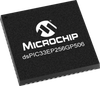
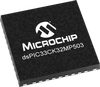
Microchip’s dsPIC33E general purpose DSC family features the highest speed 70 MIPS core with excellent performance and code density. It offers superior ADC performance, CAN communication, CTMU, Op Amps and Peripheral Trigger Generator (PTG) for high-end general purpose applications. These devices are available in various packages and with an extended (125°C) temp option.
Additional Features
Operating Conditions
3.0V to 3.6V, -40ºC to +85ºC, DC to 70 MIPS
3.0V to 3.6V, -40ºC to +150ºC, DC to 60 MIPS
dsPIC33E DSC Core
Modified Harvard Architecture
C Compiler Optimized Instruction Set
16-bit Wide Data Path
24-bit Wide Instructions
16x16 Integer Multiply Operations
32/16 and 16/16 Integer Divide Operations
Two 40-bit Accumulators with Rounding and Saturation Options
Single-Cycle Multiply and Accumulate
Single-Cycle shifts for up to 40-bit Data
16x16 Fractional Multiply/Divide Operations
Programmable Cyclic Redundancy Check (CRC)
Advanced Analog Features
ADC: Configurable as 10-bit, 1.1 Msps with four S&H or12-bit, 500 ksps with one S&H
Up to three Op amp/Comparators
Op Amp direct connection to the ADC module
Additional dedicated comparator
Programmable references with 32 voltage points for comparators
Charge Time Measurement Unit (CTMU)
Timers/Output Compare/Input Capture
12 general purpose timers
Five 16-bit and up to two 32-bit timers/counters
Four OC modules configurable as timers/counters
PTG module with two configurable timers/counters
32-bit Quadrature Encoder Interface (QEI) module configurable as a timer/counter
Four IC modules
Peripheral Trigger Generator (PTG) for scheduling complex sequences
Communication Interfaces
Two UART modules (15 Mbps)
Two 4-wire SPI modules (15 Mbps)
CAN™ module (1 Mbaud) CAN 2.0B support
Two I2C™ modules (up to 1 Mbaud) with SMBus support
PPS to allow function remap
Direct Memory Access (DMA)
4-channel DMA with user-selectable priority arbitration
UART, SPI, ADC, CAN, IC, OC, and Timers
Microchip’s dsPIC33E general purpose DSC family features the highest speed 70 MIPS core with excellent performance and code density. It offers superior ADC performance, CAN communication, CTMU, Op Amps and Peripheral Trigger Generator (PTG) for high-end general purpose applications. These devices are available in various packages and with an extended (125°C) temp option.
Additional Features
- Operating Conditions
- 3.0V to 3.6V, -40ºC to +85ºC, DC to 70 MIPS
- 3.0V to 3.6V, -40ºC to +150ºC, DC to 60 MIPS
- dsPIC33E DSC Core
- Modified Harvard Architecture
- C Compiler Optimized Instruction Set
- 16-bit Wide Data Path
- 24-bit Wide Instructions
- 16x16 Integer Multiply Operations
- 32/16 and 16/16 Integer Divide Operations
- Two 40-bit Accumulators with Rounding and Saturation Options
- Single-Cycle Multiply and Accumulate
- Single-Cycle shifts for up to 40-bit Data
- 16x16 Fractional Multiply/Divide Operations
- Programmable Cyclic Redundancy Check (CRC)
- Advanced Analog Features
- ADC: Configurable as 10-bit, 1.1 Msps with four S&H or12-bit, 500 ksps with one S&H
- Up to three Op amp/Comparators
- Op Amp direct connection to the ADC module
- Additional dedicated comparator
- Programmable references with 32 voltage points for comparators
- Charge Time Measurement Unit (CTMU)
- Timers/Output Compare/Input Capture
- 12 general purpose timers
- Five 16-bit and up to two 32-bit timers/counters
- Four OC modules configurable as timers/counters
- PTG module with two configurable timers/counters
- 32-bit Quadrature Encoder Interface (QEI) module configurable as a timer/counter
- Four IC modules
- Peripheral Trigger Generator (PTG) for scheduling complex sequences
- Communication Interfaces
- Two UART modules (15 Mbps)
- Two 4-wire SPI modules (15 Mbps)
- CAN™ module (1 Mbaud) CAN 2.0B support
- Two I2C™ modules (up to 1 Mbaud) with SMBus support
- PPS to allow function remap
- Direct Memory Access (DMA)
- 4-channel DMA with user-selectable priority arbitration
- UART, SPI, ADC, CAN, IC, OC, and Timers