Micro-Epsilon Group Circular Sensor for Structured and Metallic-Effect Surfaces colorSENSOR CFS2-M11

Description
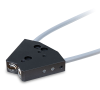
With the circular sensor, the light emitted by the controller is sent as an illuminated ring at an angle of 11° or 34° (depending on type) to the surface of the object to be tested. The diffuse back reflection (surface color) of the sample is detected by the sensor at 0° (parallel) to the surface and transmitted to the controller via an optical fiber. The ring illumination makes it possible to detect the diffuse color reflex regardless of structure or reflection. The sensors are available with different illumination angles and different spot sizes. Therefore, it is possible to measure colors with a repeatability of ΔE ≤ 0.3 in relative terms up to a working distance of 100 mm. Other sheaths and cable lengths are optionally available. The circular sensor opens up new fields of application for the colorSENSOR CFO product series. Combined with the high performance of the CFO series, the ring illumination provides even more precision due to uniform illumination. This compact combination can be universally used but is also suitable for special solutions (customer-specific adaptions). The homogeneous illumination mainly offers advantages on strongly structured or shiny-metallic surfaces while providing highest precision when distinguishing colors such as white shades. The circular sensor offers many advantages in terms of performance and installation possibilities. Due to the external controller, less installation space is required at the measuring point. Due to the standard FA connection, the optical fiber is also compatible with other controllers (previous series such as LT or WLCS).
Request a Quote Datasheet
Description
With the circular sensor, the light emitted by the controller is sent as an illuminated ring at an angle of 11° or 34° (depending on type) to the surface of the object to be tested. The diffuse back reflection (surface color) of the sample is detected by the sensor at 0° (parallel) to the surface and transmitted to the controller via an optical fiber. The ring illumination makes it possible to detect the diffuse color reflex regardless of structure or reflection. The sensors are available with different illumination angles and different spot sizes. Therefore, it is possible to measure colors with a repeatability of ΔE ≤ 0.3 in relative terms up to a working distance of 100 mm. Other sheaths and cable lengths are optionally available. The circular sensor opens up new fields of application for the colorSENSOR CFO product series. Combined with the high performance of the CFO series, the ring illumination provides even more precision due to uniform illumination. This compact combination can be universally used but is also suitable for special solutions (customer-specific adaptions). The homogeneous illumination mainly offers advantages on strongly structured or shiny-metallic surfaces while providing highest precision when distinguishing colors such as white shades. The circular sensor offers many advantages in terms of performance and installation possibilities. Due to the external controller, less installation space is required at the measuring point. Due to the standard FA connection, the optical fiber is also compatible with other controllers (previous series such as LT or WLCS).
Request a Quote Datasheet

Suppliers

Company
Product
Description
Supplier Links
Circular Sensor for Structured and Metallic-Effect Surfaces - colorSENSOR CFS2-M11 - Micro-Epsilon Group
Ortenburg, Germany
Circular Sensor for Structured and Metallic-Effect Surfaces
colorSENSOR CFS2-M11
Circular Sensor for Structured and Metallic-Effect Surfaces colorSENSOR CFS2-M11
With the circular sensor, the light emitted by the controller is sent as an illuminated ring at an angle of 11° or 34° (depending on type) to the surface of the object to be tested. The diffuse back reflection (surface color) of the sample is detected by the sensor at 0° (parallel) to the surface and transmitted to the controller via an optical fiber. The ring illumination makes it possible to detect the diffuse color reflex regardless of structure or reflection. The sensors are available with different illumination angles and different spot sizes. Therefore, it is possible to measure colors with a repeatability of ΔE ≤ 0.3 in relative terms up to a working distance of 100 mm. Other sheaths and cable lengths are optionally available. The circular sensor opens up new fields of application for the colorSENSOR CFO product series. Combined with the high performance of the CFO series, the ring illumination provides even more precision due to uniform illumination. This compact combination can be universally used but is also suitable for special solutions (customer-specific adaptions). The homogeneous illumination mainly offers advantages on strongly structured or shiny-metallic surfaces while providing highest precision when distinguishing colors such as white shades. The circular sensor offers many advantages in terms of performance and installation possibilities. Due to the external controller, less installation space is required at the measuring point. Due to the standard FA connection, the optical fiber is also compatible with other controllers (previous series such as LT or WLCS).

With the circular sensor, the light emitted by the controller is sent as an illuminated ring at an angle of 11° or 34° (depending on type) to the surface of the object to be tested. The diffuse back reflection (surface color) of the sample is detected by the sensor at 0° (parallel) to the surface and transmitted to the controller via an optical fiber. The ring illumination makes it possible to detect the diffuse color reflex regardless of structure or reflection. The sensors are available with different illumination angles and different spot sizes. Therefore, it is possible to measure colors with a repeatability of ΔE ≤ 0.3 in relative terms up to a working distance of 100 mm. Other sheaths and cable lengths are optionally available. The circular sensor opens up new fields of application for the colorSENSOR CFO product series. Combined with the high performance of the CFO series, the ring illumination provides even more precision due to uniform illumination. This compact combination can be universally used but is also suitable for special solutions (customer-specific adaptions). The homogeneous illumination mainly offers advantages on strongly structured or shiny-metallic surfaces while providing highest precision when distinguishing colors such as white shades. The circular sensor offers many advantages in terms of performance and installation possibilities. Due to the external controller, less installation space is required at the measuring point. Due to the standard FA connection, the optical fiber is also compatible with other controllers (previous series such as LT or WLCS).

Supplier's Site Datasheet

Technical Specifications

  Micro-Epsilon Group
Product Category Color Sensors
Product Number colorSENSOR CFS2-M11
Product Name Circular Sensor for Structured and Metallic-Effect Surfaces
Application Type True Color Recognition
Color Types Detected RGB (Visible)
Light Source LEDs; Fiber Optic
Unlock Full Specs
to access all available technical data

Similar Products

Circular Sensor for Structured and Metallic-Effect Surfaces - colorSENSOR CFS2-M20 - Micro-Epsilon Group
Specs
Application Type True Color Recognition
Color Types Detected RGB (Visible)
Light Source LEDs; Fiber Optic
View Details
Receiver Sensor for Testing Self-Luminous Objects - colorCONTROL MFS-K04-6 - Micro-Epsilon Group
Specs
Application Type Self-luminous object and LED testing
Color Types Detected RGB (Visible)
Light Source Fiber Optic
View Details
Transmission Sensor - colorCONTROL ACS3-TR5-200-1200 - Micro-Epsilon Group
Specs
Application Type Inline color measurement
Color Types Detected RGB (Visible)
Light Source LEDs; Fiber Optic
View Details
Transmission Sensor for Translucent Objects - colorSENSOR CFS3-C30 - Micro-Epsilon Group
Specs
Application Type True Color Recognition
Color Types Detected RGB (Visible)
Light Source LEDs; Fiber Optic
View Details