Micro-Epsilon Group Receiver Sensor for Testing Self-Luminous Objects colorCONTROL MFS-22

Description
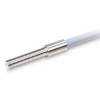
The light emitted by the luminaire under test is received by the MFS receiver sensor at 0° (parallel) to the direction of emission. The received light beams are transmitted to the controller via an optical fiber. The range of sensors offered covers a wide variety of working distances and spot sizes. Other versions in different lengths and temperature ranges are available as options. The MFS sensor (receiver sensor) in combination with the powerful MFA controllers offers extremely precise testing of light color, intensity, color temperature (CCT) and dominant wavelength (λdom). This is required, for example, when dividing LEDs into binnings, or for testing homogeneity within a light source with several individual LEDs. In addition to their outstanding performance, the receiver sensors also impress with extremely advantageous installation options. Due to the external controller, less installation space is required at the measuring point. In addition, measuring points that are far apart can be tested together with a controller. The MFS-22 consists of a POF (polymer optical fiber) and a PVC sheath with a cut end.
Request a Quote Datasheet
Description
The light emitted by the luminaire under test is received by the MFS receiver sensor at 0° (parallel) to the direction of emission. The received light beams are transmitted to the controller via an optical fiber. The range of sensors offered covers a wide variety of working distances and spot sizes. Other versions in different lengths and temperature ranges are available as options. The MFS sensor (receiver sensor) in combination with the powerful MFA controllers offers extremely precise testing of light color, intensity, color temperature (CCT) and dominant wavelength (λdom). This is required, for example, when dividing LEDs into binnings, or for testing homogeneity within a light source with several individual LEDs. In addition to their outstanding performance, the receiver sensors also impress with extremely advantageous installation options. Due to the external controller, less installation space is required at the measuring point. In addition, measuring points that are far apart can be tested together with a controller. The MFS-22 consists of a POF (polymer optical fiber) and a PVC sheath with a cut end.
Request a Quote Datasheet

Suppliers

Company
Product
Description
Supplier Links
Receiver Sensor for Testing Self-Luminous Objects - colorCONTROL MFS-22 - Micro-Epsilon Group
Ortenburg, Germany
Receiver Sensor for Testing Self-Luminous Objects
colorCONTROL MFS-22
Receiver Sensor for Testing Self-Luminous Objects colorCONTROL MFS-22
The light emitted by the luminaire under test is received by the MFS receiver sensor at 0° (parallel) to the direction of emission. The received light beams are transmitted to the controller via an optical fiber. The range of sensors offered covers a wide variety of working distances and spot sizes. Other versions in different lengths and temperature ranges are available as options. The MFS sensor (receiver sensor) in combination with the powerful MFA controllers offers extremely precise testing of light color, intensity, color temperature (CCT) and dominant wavelength (λdom). This is required, for example, when dividing LEDs into binnings, or for testing homogeneity within a light source with several individual LEDs. In addition to their outstanding performance, the receiver sensors also impress with extremely advantageous installation options. Due to the external controller, less installation space is required at the measuring point. In addition, measuring points that are far apart can be tested together with a controller. The MFS-22 consists of a POF (polymer optical fiber) and a PVC sheath with a cut end.

The light emitted by the luminaire under test is received by the MFS receiver sensor at 0° (parallel) to the direction of emission. The received light beams are transmitted to the controller via an optical fiber. The range of sensors offered covers a wide variety of working distances and spot sizes. Other versions in different lengths and temperature ranges are available as options. The MFS sensor (receiver sensor) in combination with the powerful MFA controllers offers extremely precise testing of light color, intensity, color temperature (CCT) and dominant wavelength (λdom). This is required, for example, when dividing LEDs into binnings, or for testing homogeneity within a light source with several individual LEDs. In addition to their outstanding performance, the receiver sensors also impress with extremely advantageous installation options. Due to the external controller, less installation space is required at the measuring point. In addition, measuring points that are far apart can be tested together with a controller. The MFS-22 consists of a POF (polymer optical fiber) and a PVC sheath with a cut end.

Supplier's Site Datasheet

Technical Specifications

  Micro-Epsilon Group
Product Category Color Sensors
Product Number colorCONTROL MFS-22
Product Name Receiver Sensor for Testing Self-Luminous Objects
Application Type Self-luminous object and LED testing
Color Types Detected RGB (Visible)
Light Source Fiber Optic
Unlock Full Specs
to access all available technical data

Similar Products

Color Sensor for High Offset Distances - colorSENSOR OT-3-LD-500-23 - Micro-Epsilon Group
Specs
Application Type True Color Recognition
Color Types Detected RGB (Visible)
Number of Colors in Memory 31
View Details
Sensor System for LED Tests - colorCONTROL MFA-21 - Micro-Epsilon Group
Specs
Application Type LED color, intensity and function testing
Color Types Detected RGB (Visible)
Input Voltage DC input; +24 V DC ±10%
View Details
Reflex Sensor for the Distinction of Materials and Parts - colorSENSOR CFS4-K18 - Micro-Epsilon Group
Specs
Application Type True Color Recognition
Color Types Detected RGB (Visible)
Light Source LEDs; Fiber Optic
View Details
Color Sensor for High Offset Distances - colorSENSOR OT-3-LD-200-12 - Micro-Epsilon Group
Specs
Application Type True Color Recognition
Color Types Detected RGB (Visible)
Number of Colors in Memory 31
View Details