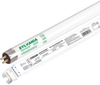
Because of environmental concerns about mercury and the need to comply with standards set by the Environmental Protection Agency, most lamp manufacturers have reduced the mercury content in their products. However, low mercury lamps, while environmentally responsible, have created challenges to emergency lighting, and the lower the mercury content, the more of a challenge they become.
Mercury affects the starting and operating characteristics of lamps in both emergency and normal modes. Philips Emergency Lighting has observed problems such as reduced lumen output and improper color rendering when low mercury compact lamps, paired with fluorescent emergency ballasts, operate in the emergency mode with a DC output. Any emergency ballast that runs a compact lamp with DC could be subject to these issues.
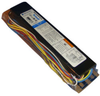
In response to problems associated with low mercury compacts and emergency lighting, Philips Emergency Lighting introduced a line of fluorescent emergency ballasts compatible with low mercury lamps. Our green product line makes it easy for buildings to “go green” without compromising emergency lighting requirements.
Open circuit design; Universal Input Voltage; 1-lamp operation for 4-pin fluorescents
| Initial Light Output: | 300 - 700 Lumens |
| Illumination Time | 90 Minute s |
| Dual Input Voltage: | 120 - 277 VAC, 50 or 60 Hz |
| AC Input Current: | 70 mA |
| AC Input Power Rating: | 5.5 W |
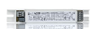
Philips Bodine compact fluorescent emergency ballasts (FEBs) are designed specifically for compact lamp fluorescent fixtures. They allow you to easily covert new or existing fluorescent fixtures into code-compliant emergency lighting.
The emergency ballasts operate most 2- and 4-pin compact lamps, including twin-tube, double twin-tube (quad), triple twin-tube, long compact and 2D lamps, and they are compatible with electronic, standard, energy-saving and dimming AC ballasts, as well as with energy management systems such as occupancy detectors and photo sensors. Philips Bodine compact FEBs are UL Listed for factory or field installation and provide at least 90 minutes of code-required emergency lighting.
Open circuit design; Universal Input Voltage; 1-lamp operation for 4-pin fluorescents
| Initial Light Output: | 300 - 700 Lumens |
| Illumination Time | 90 Minute s |
| Dual Input Voltage: | 120 - 277 VAC, 50 or 60 Hz |
| AC Input Current: | 70 mA |
| AC Input Power Rating: | 5.5 W |
Philips Emergency Lighting’s universal input fluorescent emergency ballasts (FEBs) offer a number of benefits. First, they minimize inventories. Universal input emergency ballasts are suitable for 120 through 277 VAC applications, while standard emergency ballasts are suitable for 120 VAC or 277 VAC applications. The universal FEB thus covers a broader range of applications.
These FEBs also simplify wiring and reduce wiring errors by limiting the number of leads. Universal input emergency ballasts offer only one lead, a black lead. Standard products use a black lead for 120 VAC applications and an orange lead for 277 VAC applications.
Finally, universal FEBs are suitable for use with harsh line conditions. The technology used in Philips Bodine universal input emergency ballasts allows the emergency ballast to operate well in spite of unfavorable line conditions such as high harmonic distortion, line fluctuation and noise.
Open circuit design; Universal Input Voltage;
1-lamp operation for 4-pin fluorescents
| Initial Light Output: | 300 - 700 Lumens |
| Illumination Time | 90 Minutes |
| Dual Input Voltage: | 120 - 277 VAC, 50 or 60 Hz |
| AC Input Current: | 70 mA |
| AC Input Power Rating: | 5.5 W |
| Philips Emergency Lighting | |
|---|---|
| Product Category | Ballasts |
| Product Number | CF94GU |
| Product Name | Fluorescent Emergency Ballast |