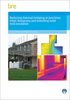


Learn how to minimise the effects of thermal bridging or inconsistency in thermal envelope performance when designing and installing solid wall insulation during refurbishment. This guide sets out clear principles and methods for reducing thermal bridging effects, maximising carbon emission reductions and minimising the risk of condensation.
Author: Caroline Weeks, Tim Ward and Colin King
Publish Date: 12/20/2013
ISBN: 978-1-84806-350-1
Abstract:
With the advent of the Green Deal, Energy Company Obligation (ECO) and other financial incentives to improve the UK’s existing building stock, there has never been a more relevant time to push the construction industry towards better performance. Current practice during refurbishment does little or nothing to minimise the effects of thermal bridging or inconsistency in thermal envelope performance. This guide sets out clear principles and methods that should be considered and adopted during the design and installation of solid wall insulation in order to reduce thermal bridging effects, maximise carbon dioxide (CO2) emission reductions and minimise the risk of condensation.
The effect of installing external and internal wall insulation in typical solid wall homes has been modelled for junctions with windows, eaves, floors and party walls. Potential problems are considered, taking examples from recent refurbishment projects in which BRE has been involved. This BRE Trust Report will be a useful resource for public and private clients looking to improve the performance of their properties and for architects/designers
Reducing thermal bridging at junctions when designing and installing solid wall insulation
| IHS BRE Press | Accuris | |
|---|---|---|
| Product Category | Technical Books | Standards and Technical Documents |
| Product Number | FB61 | FB61 |
| Product Name | Reducing Thermal Bridging At Junctions When Designing and Installing Solid Wall Insulation | Reducing thermal bridging at junctions when designing and installing solid wall insulation |