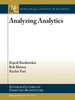
IEEE - Institute of Electrical and Electronics Engineers, Inc. Analyzing Analytics

Description
This book aims to achieve the following goals: (1) to provide a high-level survey of key analytics models and algorithms without going into mathematical details; (2) to analyze the usage patterns of these models; and (3) to discuss opportunities for accelerating analytics workloads using software, hardware, and system approaches. The book first describes 14 key analytics models (exemplars) that span data mining, machine learning, and data management domains. For each analytics exemplar, we summarize its computational and runtime patterns and apply the information to evaluate parallelization and acceleration alternatives for that exemplar. Using case studies from important application domains such as deep learning, text analytics, and business intelligence (BI), we demonstrate how various software and hardware acceleration strategies are implemented in practice. This book is intended for both experienced professionals and students who are interested in understanding core algorithms behind analytics workloads. It is designed to serve as a guide for addressing various open problems in accelerating analytics workloads, e.g., new architectural features for supporting analytics workloads, impact on programming models and runtime systems, and designing analytics systems.
Request a Quote

Suppliers

Company
Product
Description
Supplier Links
Analyzing Analytics
This book aims to achieve the following goals: (1) to provide a high-level survey of key analytics models and algorithms without going into mathematical details; (2) to analyze the usage patterns of these models; and (3) to discuss opportunities for accelerating analytics workloads using software, hardware, and system approaches. The book first describes 14 key analytics models (exemplars) that span data mining, machine learning, and data management domains. For each analytics exemplar, we summarize its computational and runtime patterns and apply the information to evaluate parallelization and acceleration alternatives for that exemplar. Using case studies from important application domains such as deep learning, text analytics, and business intelligence (BI), we demonstrate how various software and hardware acceleration strategies are implemented in practice. This book is intended for both experienced professionals and students who are interested in understanding core algorithms behind analytics workloads. It is designed to serve as a guide for addressing various open problems in accelerating analytics workloads, e.g., new architectural features for supporting analytics workloads, impact on programming models and runtime systems, and designing analytics systems.

This book aims to achieve the following goals: (1) to provide a high-level survey of key analytics models and algorithms without going into mathematical details; (2) to analyze the usage patterns of these models; and (3) to discuss opportunities for accelerating analytics workloads using software, hardware, and system approaches. The book first describes 14 key analytics models (exemplars) that span data mining, machine learning, and data management domains. For each analytics exemplar, we summarize its computational and runtime patterns and apply the information to evaluate parallelization and acceleration alternatives for that exemplar. Using case studies from important application domains such as deep learning, text analytics, and business intelligence (BI), we demonstrate how various software and hardware acceleration strategies are implemented in practice. This book is intended for both experienced professionals and students who are interested in understanding core algorithms behind analytics workloads. It is designed to serve as a guide for addressing various open problems in accelerating analytics workloads, e.g., new architectural features for supporting analytics workloads, impact on programming models and runtime systems, and designing analytics systems.

Supplier's Site

Technical Specifications

  IEEE - Institute of Electrical and Electronics Engineers, Inc.
Product Category Technical Books
Product Name Analyzing Analytics
Unlock Full Specs
to access all available technical data

Similar Products

IEEE - Institute of Electrical and Electronics Engineers, Inc.
View Details
Analysis Techniques for Information Security -  - IEEE -  Institute of Electrical and Electronics Engineers, Inc.
IEEE - Institute of Electrical and Electronics Engineers, Inc.
View Details
Artificial Experts: Social Knowledge and Intelligent Machines -  - IEEE -  Institute of Electrical and Electronics Engineers, Inc.
IEEE - Institute of Electrical and Electronics Engineers, Inc.
View Details