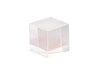
HG Optronics, Inc. Polarizing Beamsplitter Cubes Mounted And Unmounted

Description
Polarization Beamsplitter Cubes are constructed by cemented two right angle prisms, the hypotenuse of one prism is coated with polarization dielectric coating. When used with normal incident, un-polarized light, the incident beam is separated into two polarized beams, p-polarized component is passed straight through, s-polarized component is reflected out at 90deg. 1.1、What is a Polarizing Beamsplitter Cube? A polarizing beamsplitter cube consists of two right angle prisms cemented together. The hypotenuse face of one prism is coated with a special multi layer dielectric coating. When circularly polarized or natural light enters the cube vertically, it separated into two linearly polarized beams. The transmitted beam is P-polarized while the reflected beam is S-polarized. And when a linearly polarized light comes in, it similarly divided into two beams. But the energy ratio of the two outgoing beams depends on the polarization of the incident beam. Polarizing beamsplitter cubes are available for many laser wavelengths and broadband ranges. 1.2、How does a polarizing beamsplitter Cube work? Polarizing Beamsplitter is designed to split unpolarized light at a specific Reflection/Transmiss ion (R/T) ratio with unspecified polarization tendencies. Polarizing beamsplitters are designed to split light into reflected S-polarized and transmitted P-polarized beams. 1.3、What is a Polarizing beamsplitter Cube used for? Beamsplitter is also a kind of filter, it is used to split or combine laser beam. However Polarization BeamSplitters are used to split or combine two perpendicular polarization laser beam. The performance of beam splitter depends on the coating specifications. They are common components in laser or illumination systems. Also ideal for fluorescence applications, optical interferometry, or life science or semiconductor instrumentation. Light can be split by percentage of overall intensity, wavelength, or polarization state. To select a suitable beamsplitter, you need to consider the type, coating, transmission range and damage threshold.

Suppliers

Company
Product
Description
Supplier Links
Polarizing Beamsplitter Cubes Mounted And Unmounted -  - HG Optronics, Inc.
Fuzhou, Fujian, China
Polarizing Beamsplitter Cubes Mounted And Unmounted
Polarization Beamsplitter Cubes are constructed by cemented two right angle prisms, the hypotenuse of one prism is coated with polarization dielectric coating. When used with normal incident, un-polarized light, the incident beam is separated into two polarized beams, p-polarized component is passed straight through, s-polarized component is reflected out at 90deg. 1.1、What is a Polarizing Beamsplitter Cube? A polarizing beamsplitter cube consists of two right angle prisms cemented together. The hypotenuse face of one prism is coated with a special multi layer dielectric coating. When circularly polarized or natural light enters the cube vertically, it separated into two linearly polarized beams. The transmitted beam is P-polarized while the reflected beam is S-polarized. And when a linearly polarized light comes in, it similarly divided into two beams. But the energy ratio of the two outgoing beams depends on the polarization of the incident beam. Polarizing beamsplitter cubes are available for many laser wavelengths and broadband ranges. 1.2、How does a polarizing beamsplitter Cube work? Polarizing Beamsplitter is designed to split unpolarized light at a specific Reflection/Transmiss ion (R/T) ratio with unspecified polarization tendencies. Polarizing beamsplitters are designed to split light into reflected S-polarized and transmitted P-polarized beams. 1.3、What is a Polarizing beamsplitter Cube used for? Beamsplitter is also a kind of filter, it is used to split or combine laser beam. However Polarization BeamSplitters are used to split or combine two perpendicular polarization laser beam. The performance of beam splitter depends on the coating specifications. They are common components in laser or illumination systems. Also ideal for fluorescence applications, optical interferometry, or life science or semiconductor instrumentation. Light can be split by percentage of overall intensity, wavelength, or polarization state. To select a suitable beamsplitter, you need to consider the type, coating, transmission range and damage threshold.

Polarization Beamsplitter Cubes are constructed by cemented two right angle prisms, the hypotenuse of one prism is coated with polarization dielectric coating.

When used with normal incident, un-polarized light, the incident beam is separated into two polarized beams, p-polarized component is passed straight through, s-polarized component is reflected out at 90deg.

1.1、What is a Polarizing Beamsplitter Cube?

A polarizing beamsplitter cube consists of two right angle prisms cemented together. The hypotenuse face of one prism is coated with a special multi layer dielectric coating. When circularly polarized or natural light enters the cube vertically, it separated into two linearly polarized beams. The transmitted beam is P-polarized while the reflected beam is S-polarized. And when a linearly polarized light comes in, it similarly divided into two beams. But the energy ratio of the two outgoing beams depends on the polarization of the incident beam. Polarizing beamsplitter cubes are available for many laser wavelengths and broadband ranges.

1.2、How does a polarizing beamsplitter Cube work?

Polarizing Beamsplitter is designed to split unpolarized light at a specific Reflection/Transmission (R/T) ratio with unspecified polarization tendencies.

Polarizing beamsplitters are designed to split light into reflected S-polarized and transmitted P-polarized beams.

1.3、What is a Polarizing beamsplitter Cube used for?

Beamsplitter is also a kind of filter, it is used to split or combine laser beam. However Polarization BeamSplitters are used to split or combine two perpendicular polarization laser beam. The performance of beam splitter depends on the coating specifications. They are common components in laser or illumination systems. Also ideal for fluorescence applications, optical interferometry, or life science or semiconductor instrumentation. Light can be split by percentage of overall intensity, wavelength, or polarization state.

To select a suitable beamsplitter, you need to consider the type, coating, transmission range and damage threshold.

Supplier's Site

Technical Specifications

  HG Optronics, Inc.
Product Category Polarizing Cube Beamsplitters
Product Name Polarizing Beamsplitter Cubes Mounted And Unmounted
Polarizer Construction Cement
Polarizer Features Anti-Reflection Coating
Polarizer Material BK7; UVgr FS; Other Material; BK7, Fused Silica, Borofloat etc. Glass
Unlock Full Specs
to access all available technical data

Similar Products

Broadband Dielectric Beamsplitters -  - CASTECH, Inc.
Specs
Side Length 0.1300 mm (0.0051 inch)
Polarizer Features Anti-Reflection Coating
Type of Antireflection Coating Multilayer coating: Ravg<0.75% @ 45° incidence
View Details
Cube Beamsplitter, Polarizing, 12.7 mm, 405 nm Laser Line - 05BC16PC.13 - Newport MKS
Specs
Side Length 12.7 mm (0.5000 inch)
Polarizer Features Anti-Reflection Coating
Type of Antireflection Coating Laser line polarizing
View Details
Polarization Beamsplitter Cube and Waveplate -  - CeNing Optics Co., Ltd.
Specs
Side Length 18 to 30 mm (0.7087 to 1.18 inch)
Polarizer Features Anti-Reflection Coating
Type of Antireflection Coating AR Coating
View Details
Visible And NIR Plate Beamsplitters -  - HG Optronics, Inc.
Specs
Polarizer Features Anti-Reflection Coating
Type of Antireflection Coating Hypotenuse face Polarization Beamsplitter Coating All Input and Output face AR Coating
Polarizer Material BK7; Other Material; BK7 Grade A Optical Glass
View Details