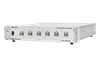
GL Communications, Inc. T1 or E1 Real-Time SS7 Protocol Analyzer XX120

Description
SS7 (Signaling System 7) separates the information required to set up and manage telephone calls in the Public Switched Telephone Network (PSTN) onto a separate packet switched network (Signaling Network). It uses Message Signal Units (MSUs), Link Status Signal Units (LSSUs), and Fill-In Signal Units (FISUs) as signal units. The main protocols include MTP (Message Transfer Part - Level 1 to 3), SCCP (Signaling Connection Control Part), and ISUP (ISDN User Part). As a result of introducing new IN services there is a demand for increase in SS7 network capacity. SS7 High Speed Link (HSL) is defined to meet this requirement which uses entire T1 (or E1) bandwidth instead of just 56 kbit/s or 64kbit/s to carry SS7 signaling. The HSL technology can be implemented either using unchannelized HDLC (over MTP2), ATM (ATM layers replace MTP1 and 2), or SIGTRAN. Traditional LSL links will have up to 24 or 31 links per T1or E1, respectively, while HSL and ATM both have only one link per T1 or E1. GL's SS7 Analyzer supports decoding different SS7 layers like MTP2, MTP3, ISUP, TUP, SCCP, INAP (CS1, CS2), IUP, BICC, BISUP, BTUP and many application layer protocols from GSM/GPRS/UMTS network like MAP, CAMEL(CAP), and so on. The SS7 Analyzer supports decoding of both Low Speed Links (LSL) of 56 kbps or 64 kbps DS0 links or high-speed 1.544 Mbps or 2 Mbps unchannelized T1/E1 High Speed Signaling Links (HSL). Both real-time and off-line analysis present information in four layers: Raw HDLC Frame data as a hexadecimal and ASCII octet dump MTP2 and MTP3 information ISUP, TUP, SCCP, BICC, INAP, MAP, BTUP etc. information Different SS7 layers like MTP2, MTP3, ISUP, TUP, SCCP, INAP (CS1, CS2), IUP, BICC, BISUP, BTUP and many application layer protocols from GSM/GPRS network like MAP, CAMEL(CAP), IS 41 etc are decoded according to ANSI/ITU/ETSI/CHINA/ UK standards and displayed in an organized fashion. GL Communications supports the following types of SS7 analyzers: Real-time SS7 Analyzer (Pre-requisites: GL's field proven E1 or T1 internal cards or USB Laptop E1 or T1 external units, required licenses and Windows XP (or higher) Operating System) Remote/Offline SS7 Analyzers (Pre-requisites: Hardware Dongles and Windows XP (or higher) Operating System) Also, visit GL's SIGTRAN protocol decode web page for a description of SIGTRAN - used to carry Q.931 or SS7 ISUP messages between IP nodes such as a Signaling Gateway and Media Gateway Controller or Media Gateway. In addition the following SS7 application is supported that further help in emulating SS7 protocol Scripted SS7 Emulation using MAPS™ SS7 Emulation using DCOSS SS7 Analyzer Main Features: Supports analysis of SSP-STP (A link, E link), STP-STP (B link, C link), & SSP-SSP (F link) interfaces Supports analysis of GSM/UMTS MAP interfaces B (Interface b/w the MSC and its associated VLR) C (Interface b/w the HLR and the MSC) D (Interface b/w the HLR and the VLR) E (Interface b/w MSCs) F (Interface b/w MSC and EIR) H (Interface between HLR and AuC) J (Interface b/w the HLR and the gsmSCF) Displays Summary, Detail, Hex-dump, Statistics, and Call Detail Views. Summary View displays MTP2, MTP3 information and SS7 Message types, Called and Calling number, SCCP message type, SSN, INAP information, IUP information, BICC message type, and more in a tabular format. Detail View displays decodes of a user-selected frame from the Summary View, the contents of this view can also be copied to clipboard. Capable of decoding many important protocols from GSM/GPRS network i.e. MAP, CAP. Hex Dump View displays the frame information in HEX and ASCII format, the contents of this view can also be copied to clipboard. Streams can be captured on the selected time slots (contiguous or non-contiguous), sub-channels, or full bandwidth. Frames can be transmitted/captured in either, n x 64 kbps, or n x 56 kbps data channels. Statistics View displays call and MSU statistics at any link or entire link set. Call trace isolates call specific information i.e. status of each call (i.e. active/completed), duration of completed call, OPC, DPC, CIC, Called and Calling Party Numbers, and more. Exports Summary View information to a comma delimited file for subsequent import into a database or spreadsheet. Capability to export detail decodes information to an ASCII file. Recorded trace files can be played back using HDLC Playback application. Flexibility to select/hide the call trace columns as required by the user. Call Detail Recording feature includes data link groups that help in defining the direction of the calls in a given network and form logical groups comprised of unidirectional (either 'Forward' or 'Backward') data links. Supports filtering and search based on Frame length, FSN, BSN, SSN, and so on. Any protocol field can be added to the summary view, filtering, and search features providing users more flexibility to monitor required protocol fields. HDLC (according to Q.921) based SS7 frames are parsed based on ANSI and ITU standards. Ability to configure the .ini file for custom decoding options such as SSN value of INAP, MAP, CAP, CNAM, TCAP and IS41, and more. Remote monitoring capability using GL's Network Surveillance System. Additional features supported by real-time/ remote SS7 analyzer are: Real-time filter and search features on various SS7 message types. Streams can be captured on the selected time slots (contiguous or non-contiguous), sub-channels or full bandwidth. Frames may also be contained in either one, n x 64 kbps, or n x 56 kbps data channels. The following variations are accommodated in the software: inverted or non-inverted data, byte reversal or non-reversal. Supports decoding of frames with FCS of 16 bits and 32 bits, or none Recorded trace files can be played back using HDLC Playback application. Multiple remote clients may access a single T1/E1 server. Also, the T1/E1 server is fully functional while being accessed as a server. Thus, a user may perform T1/E1 operations locally on the server while a client is accessing the same server, in real time.(For Remote Analyzers only). Multiple streams of SS7 traffic on various T1/E1 channels can be simultaneously decoded with different GUI instances. Additional features supported by Offline SS7 Analyzer: Trace files for analysis can be loaded through simple command-line arguments. Multiple trace files can be loaded simultaneously with different GUI instances for offline analysis.
Datasheet
Description
SS7 (Signaling System 7) separates the information required to set up and manage telephone calls in the Public Switched Telephone Network (PSTN) onto a separate packet switched network (Signaling Network). It uses Message Signal Units (MSUs), Link Status Signal Units (LSSUs), and Fill-In Signal Units (FISUs) as signal units. The main protocols include MTP (Message Transfer Part - Level 1 to 3), SCCP (Signaling Connection Control Part), and ISUP (ISDN User Part). As a result of introducing new IN services there is a demand for increase in SS7 network capacity. SS7 High Speed Link (HSL) is defined to meet this requirement which uses entire T1 (or E1) bandwidth instead of just 56 kbit/s or 64kbit/s to carry SS7 signaling. The HSL technology can be implemented either using unchannelized HDLC (over MTP2), ATM (ATM layers replace MTP1 and 2), or SIGTRAN. Traditional LSL links will have up to 24 or 31 links per T1or E1, respectively, while HSL and ATM both have only one link per T1 or E1. GL's SS7 Analyzer supports decoding different SS7 layers like MTP2, MTP3, ISUP, TUP, SCCP, INAP (CS1, CS2), IUP, BICC, BISUP, BTUP and many application layer protocols from GSM/GPRS/UMTS network like MAP, CAMEL(CAP), and so on. The SS7 Analyzer supports decoding of both Low Speed Links (LSL) of 56 kbps or 64 kbps DS0 links or high-speed 1.544 Mbps or 2 Mbps unchannelized T1/E1 High Speed Signaling Links (HSL). Both real-time and off-line analysis present information in four layers: Raw HDLC Frame data as a hexadecimal and ASCII octet dump MTP2 and MTP3 information ISUP, TUP, SCCP, BICC, INAP, MAP, BTUP etc. information Different SS7 layers like MTP2, MTP3, ISUP, TUP, SCCP, INAP (CS1, CS2), IUP, BICC, BISUP, BTUP and many application layer protocols from GSM/GPRS network like MAP, CAMEL(CAP), IS 41 etc are decoded according to ANSI/ITU/ETSI/CHINA/ UK standards and displayed in an organized fashion. GL Communications supports the following types of SS7 analyzers: Real-time SS7 Analyzer (Pre-requisites: GL's field proven E1 or T1 internal cards or USB Laptop E1 or T1 external units, required licenses and Windows XP (or higher) Operating System) Remote/Offline SS7 Analyzers (Pre-requisites: Hardware Dongles and Windows XP (or higher) Operating System) Also, visit GL's SIGTRAN protocol decode web page for a description of SIGTRAN - used to carry Q.931 or SS7 ISUP messages between IP nodes such as a Signaling Gateway and Media Gateway Controller or Media Gateway. In addition the following SS7 application is supported that further help in emulating SS7 protocol Scripted SS7 Emulation using MAPS™ SS7 Emulation using DCOSS SS7 Analyzer Main Features: Supports analysis of SSP-STP (A link, E link), STP-STP (B link, C link), & SSP-SSP (F link) interfaces Supports analysis of GSM/UMTS MAP interfaces B (Interface b/w the MSC and its associated VLR) C (Interface b/w the HLR and the MSC) D (Interface b/w the HLR and the VLR) E (Interface b/w MSCs) F (Interface b/w MSC and EIR) H (Interface between HLR and AuC) J (Interface b/w the HLR and the gsmSCF) Displays Summary, Detail, Hex-dump, Statistics, and Call Detail Views. Summary View displays MTP2, MTP3 information and SS7 Message types, Called and Calling number, SCCP message type, SSN, INAP information, IUP information, BICC message type, and more in a tabular format. Detail View displays decodes of a user-selected frame from the Summary View, the contents of this view can also be copied to clipboard. Capable of decoding many important protocols from GSM/GPRS network i.e. MAP, CAP. Hex Dump View displays the frame information in HEX and ASCII format, the contents of this view can also be copied to clipboard. Streams can be captured on the selected time slots (contiguous or non-contiguous), sub-channels, or full bandwidth. Frames can be transmitted/captured in either, n x 64 kbps, or n x 56 kbps data channels. Statistics View displays call and MSU statistics at any link or entire link set. Call trace isolates call specific information i.e. status of each call (i.e. active/completed), duration of completed call, OPC, DPC, CIC, Called and Calling Party Numbers, and more. Exports Summary View information to a comma delimited file for subsequent import into a database or spreadsheet. Capability to export detail decodes information to an ASCII file. Recorded trace files can be played back using HDLC Playback application. Flexibility to select/hide the call trace columns as required by the user. Call Detail Recording feature includes data link groups that help in defining the direction of the calls in a given network and form logical groups comprised of unidirectional (either 'Forward' or 'Backward') data links. Supports filtering and search based on Frame length, FSN, BSN, SSN, and so on. Any protocol field can be added to the summary view, filtering, and search features providing users more flexibility to monitor required protocol fields. HDLC (according to Q.921) based SS7 frames are parsed based on ANSI and ITU standards. Ability to configure the .ini file for custom decoding options such as SSN value of INAP, MAP, CAP, CNAM, TCAP and IS41, and more. Remote monitoring capability using GL's Network Surveillance System. Additional features supported by real-time/ remote SS7 analyzer are: Real-time filter and search features on various SS7 message types. Streams can be captured on the selected time slots (contiguous or non-contiguous), sub-channels or full bandwidth. Frames may also be contained in either one, n x 64 kbps, or n x 56 kbps data channels. The following variations are accommodated in the software: inverted or non-inverted data, byte reversal or non-reversal. Supports decoding of frames with FCS of 16 bits and 32 bits, or none Recorded trace files can be played back using HDLC Playback application. Multiple remote clients may access a single T1/E1 server. Also, the T1/E1 server is fully functional while being accessed as a server. Thus, a user may perform T1/E1 operations locally on the server while a client is accessing the same server, in real time.(For Remote Analyzers only). Multiple streams of SS7 traffic on various T1/E1 channels can be simultaneously decoded with different GUI instances. Additional features supported by Offline SS7 Analyzer: Trace files for analysis can be loaded through simple command-line arguments. Multiple trace files can be loaded simultaneously with different GUI instances for offline analysis.
Datasheet

Suppliers

Company
Product
Description
Supplier Links
T1 or E1 Real-Time SS7 Protocol Analyzer - XX120 - GL Communications, Inc.
Gaithersburg, MD, United States
T1 or E1 Real-Time SS7 Protocol Analyzer
XX120
T1 or E1 Real-Time SS7 Protocol Analyzer XX120
SS7 (Signaling System 7) separates the information required to set up and manage telephone calls in the Public Switched Telephone Network (PSTN) onto a separate packet switched network (Signaling Network). It uses Message Signal Units (MSUs), Link Status Signal Units (LSSUs), and Fill-In Signal Units (FISUs) as signal units. The main protocols include MTP (Message Transfer Part - Level 1 to 3), SCCP (Signaling Connection Control Part), and ISUP (ISDN User Part). As a result of introducing new IN services there is a demand for increase in SS7 network capacity. SS7 High Speed Link (HSL) is defined to meet this requirement which uses entire T1 (or E1) bandwidth instead of just 56 kbit/s or 64kbit/s to carry SS7 signaling. The HSL technology can be implemented either using unchannelized HDLC (over MTP2), ATM (ATM layers replace MTP1 and 2), or SIGTRAN. Traditional LSL links will have up to 24 or 31 links per T1or E1, respectively, while HSL and ATM both have only one link per T1 or E1. GL's SS7 Analyzer supports decoding different SS7 layers like MTP2, MTP3, ISUP, TUP, SCCP, INAP (CS1, CS2), IUP, BICC, BISUP, BTUP and many application layer protocols from GSM/GPRS/UMTS network like MAP, CAMEL(CAP), and so on. The SS7 Analyzer supports decoding of both Low Speed Links (LSL) of 56 kbps or 64 kbps DS0 links or high-speed 1.544 Mbps or 2 Mbps unchannelized T1/E1 High Speed Signaling Links (HSL). Both real-time and off-line analysis present information in four layers: Raw HDLC Frame data as a hexadecimal and ASCII octet dump MTP2 and MTP3 information ISUP, TUP, SCCP, BICC, INAP, MAP, BTUP etc. information Different SS7 layers like MTP2, MTP3, ISUP, TUP, SCCP, INAP (CS1, CS2), IUP, BICC, BISUP, BTUP and many application layer protocols from GSM/GPRS network like MAP, CAMEL(CAP), IS 41 etc are decoded according to ANSI/ITU/ETSI/CHINA/ UK standards and displayed in an organized fashion. GL Communications supports the following types of SS7 analyzers: Real-time SS7 Analyzer (Pre-requisites: GL's field proven E1 or T1 internal cards or USB Laptop E1 or T1 external units, required licenses and Windows XP (or higher) Operating System) Remote/Offline SS7 Analyzers (Pre-requisites: Hardware Dongles and Windows XP (or higher) Operating System) Also, visit GL's SIGTRAN protocol decode web page for a description of SIGTRAN - used to carry Q.931 or SS7 ISUP messages between IP nodes such as a Signaling Gateway and Media Gateway Controller or Media Gateway. In addition the following SS7 application is supported that further help in emulating SS7 protocol Scripted SS7 Emulation using MAPS™ SS7 Emulation using DCOSS SS7 Analyzer Main Features: Supports analysis of SSP-STP (A link, E link), STP-STP (B link, C link), & SSP-SSP (F link) interfaces Supports analysis of GSM/UMTS MAP interfaces B (Interface b/w the MSC and its associated VLR) C (Interface b/w the HLR and the MSC) D (Interface b/w the HLR and the VLR) E (Interface b/w MSCs) F (Interface b/w MSC and EIR) H (Interface between HLR and AuC) J (Interface b/w the HLR and the gsmSCF) Displays Summary, Detail, Hex-dump, Statistics, and Call Detail Views. Summary View displays MTP2, MTP3 information and SS7 Message types, Called and Calling number, SCCP message type, SSN, INAP information, IUP information, BICC message type, and more in a tabular format. Detail View displays decodes of a user-selected frame from the Summary View, the contents of this view can also be copied to clipboard. Capable of decoding many important protocols from GSM/GPRS network i.e. MAP, CAP. Hex Dump View displays the frame information in HEX and ASCII format, the contents of this view can also be copied to clipboard. Streams can be captured on the selected time slots (contiguous or non-contiguous), sub-channels, or full bandwidth. Frames can be transmitted/captured in either, n x 64 kbps, or n x 56 kbps data channels. Statistics View displays call and MSU statistics at any link or entire link set. Call trace isolates call specific information i.e. status of each call (i.e. active/completed), duration of completed call, OPC, DPC, CIC, Called and Calling Party Numbers, and more. Exports Summary View information to a comma delimited file for subsequent import into a database or spreadsheet. Capability to export detail decodes information to an ASCII file. Recorded trace files can be played back using HDLC Playback application. Flexibility to select/hide the call trace columns as required by the user. Call Detail Recording feature includes data link groups that help in defining the direction of the calls in a given network and form logical groups comprised of unidirectional (either 'Forward' or 'Backward') data links. Supports filtering and search based on Frame length, FSN, BSN, SSN, and so on. Any protocol field can be added to the summary view, filtering, and search features providing users more flexibility to monitor required protocol fields. HDLC (according to Q.921) based SS7 frames are parsed based on ANSI and ITU standards. Ability to configure the .ini file for custom decoding options such as SSN value of INAP, MAP, CAP, CNAM, TCAP and IS41, and more. Remote monitoring capability using GL's Network Surveillance System. Additional features supported by real-time/ remote SS7 analyzer are: Real-time filter and search features on various SS7 message types. Streams can be captured on the selected time slots (contiguous or non-contiguous), sub-channels or full bandwidth. Frames may also be contained in either one, n x 64 kbps, or n x 56 kbps data channels. The following variations are accommodated in the software: inverted or non-inverted data, byte reversal or non-reversal. Supports decoding of frames with FCS of 16 bits and 32 bits, or none Recorded trace files can be played back using HDLC Playback application. Multiple remote clients may access a single T1/E1 server. Also, the T1/E1 server is fully functional while being accessed as a server. Thus, a user may perform T1/E1 operations locally on the server while a client is accessing the same server, in real time.(For Remote Analyzers only). Multiple streams of SS7 traffic on various T1/E1 channels can be simultaneously decoded with different GUI instances. Additional features supported by Offline SS7 Analyzer: Trace files for analysis can be loaded through simple command-line arguments. Multiple trace files can be loaded simultaneously with different GUI instances for offline analysis.

SS7 (Signaling System 7) separates the information required to set up and manage telephone calls in the Public Switched Telephone Network (PSTN) onto a separate packet switched network (Signaling Network). It uses Message Signal Units (MSUs), Link Status Signal Units (LSSUs), and Fill-In Signal Units (FISUs) as signal units. The main protocols include MTP (Message Transfer Part - Level 1 to 3), SCCP (Signaling Connection Control Part), and ISUP (ISDN User Part).

As a result of introducing new IN services there is a demand for increase in SS7 network capacity. SS7 High Speed Link (HSL) is defined to meet this requirement which uses entire T1 (or E1) bandwidth instead of just 56 kbit/s or 64kbit/s to carry SS7 signaling. The HSL technology can be implemented either using unchannelized HDLC (over MTP2), ATM (ATM layers replace MTP1 and 2), or SIGTRAN. Traditional LSL links will have up to 24 or 31 links per T1or E1, respectively, while HSL and ATM both have only one link per T1 or E1.

GL's SS7 Analyzer supports decoding different SS7 layers like MTP2, MTP3, ISUP, TUP, SCCP, INAP (CS1, CS2), IUP, BICC, BISUP, BTUP and many application layer protocols from GSM/GPRS/UMTS network like MAP, CAMEL(CAP), and so on. The SS7 Analyzer supports decoding of both Low Speed Links (LSL) of 56 kbps or 64 kbps DS0 links or high-speed 1.544 Mbps or 2 Mbps unchannelized T1/E1 High Speed Signaling Links (HSL).

Both real-time and off-line analysis present information in four layers:

  • Raw HDLC Frame data as a hexadecimal and ASCII octet dump
  • MTP2 and MTP3 information
  • ISUP, TUP, SCCP, BICC, INAP, MAP, BTUP etc. information

Different SS7 layers like MTP2, MTP3, ISUP, TUP, SCCP, INAP (CS1, CS2), IUP, BICC, BISUP, BTUP and many application layer protocols from GSM/GPRS network like MAP, CAMEL(CAP), IS 41 etc are decoded according to ANSI/ITU/ETSI/CHINA/UK standards and displayed in an organized fashion.

GL Communications supports the following types of SS7 analyzers:

  • Real-time SS7 Analyzer (Pre-requisites: GL's field proven E1 or T1 internal cards or USB Laptop E1 or T1 external units, required licenses and Windows XP (or higher) Operating System)
  • Remote/Offline SS7 Analyzers (Pre-requisites: Hardware Dongles and Windows XP (or higher) Operating System)

Also, visit GL's SIGTRAN protocol decode web page for a description of SIGTRAN - used to carry Q.931 or SS7 ISUP messages between IP nodes such as a Signaling Gateway and Media Gateway Controller or Media Gateway.

In addition the following SS7 application is supported that further help in emulating SS7 protocol

  • Scripted SS7 Emulation using MAPS™
  • SS7 Emulation using DCOSS

SS7 Analyzer Main Features:

  • Supports analysis of SSP-STP (A link, E link), STP-STP (B link, C link), & SSP-SSP (F link) interfaces
  • Supports analysis of GSM/UMTS MAP interfaces
    • B (Interface b/w the MSC and its associated VLR)
    • C (Interface b/w the HLR and the MSC)
    • D (Interface b/w the HLR and the VLR)
    • E (Interface b/w MSCs)
    • F (Interface b/w MSC and EIR)
    • H (Interface between HLR and AuC)
    • J (Interface b/w the HLR and the gsmSCF)
  • Displays Summary, Detail, Hex-dump, Statistics, and Call Detail Views.
  • Summary View displays MTP2, MTP3 information and SS7 Message types, Called and Calling number, SCCP message type, SSN, INAP information, IUP information, BICC message type, and more in a tabular format.
  • Detail View displays decodes of a user-selected frame from the Summary View, the contents of this view can also be copied to clipboard.
  • Capable of decoding many important protocols from GSM/GPRS network i.e. MAP, CAP.
  • Hex Dump View displays the frame information in HEX and ASCII format, the contents of this view can also be copied to clipboard.
  • Streams can be captured on the selected time slots (contiguous or non-contiguous), sub-channels, or full bandwidth. Frames can be transmitted/captured in either, n x 64 kbps, or n x 56 kbps data channels.
  • Statistics View displays call and MSU statistics at any link or entire link set.
  • Call trace isolates call specific information i.e. status of each call (i.e. active/completed), duration of completed call, OPC, DPC, CIC, Called and Calling Party Numbers, and more.
  • Exports Summary View information to a comma delimited file for subsequent import into a database or spreadsheet.
  • Capability to export detail decodes information to an ASCII file.
  • Recorded trace files can be played back using HDLC Playback application.
  • Flexibility to select/hide the call trace columns as required by the user.
  • Call Detail Recording feature includes data link groups that help in defining the direction of the calls in a given network and form logical groups comprised of unidirectional (either 'Forward' or 'Backward') data links.
  • Supports filtering and search based on Frame length, FSN, BSN, SSN, and so on.
  • Any protocol field can be added to the summary view, filtering, and search features providing users more flexibility to monitor required protocol fields.
  • HDLC (according to Q.921) based SS7 frames are parsed based on ANSI and ITU standards.
  • Ability to configure the .ini file for custom decoding options such as SSN value of INAP, MAP, CAP, CNAM, TCAP and IS41, and more.
  • Remote monitoring capability using GL's Network Surveillance System.

Additional features supported by real-time/ remote SS7 analyzer are:

  • Real-time filter and search features on various SS7 message types.
  • Streams can be captured on the selected time slots (contiguous or non-contiguous), sub-channels or full bandwidth. Frames may also be contained in either one, n x 64 kbps, or n x 56 kbps data channels.
  • The following variations are accommodated in the software: inverted or non-inverted data, byte reversal or non-reversal.
  • Supports decoding of frames with FCS of 16 bits and 32 bits, or none
  • Recorded trace files can be played back using HDLC Playback application.
  • Multiple remote clients may access a single T1/E1 server. Also, the T1/E1 server is fully functional while being accessed as a server. Thus, a user may perform T1/E1 operations locally on the server while a client is accessing the same server, in real time.(For Remote Analyzers only).
  • Multiple streams of SS7 traffic on various T1/E1 channels can be simultaneously decoded with different GUI instances.

Additional features supported by Offline SS7 Analyzer:

  • Trace files for analysis can be loaded through simple command-line arguments.
  • Multiple trace files can be loaded simultaneously with different GUI instances for offline analysis.
Supplier's Site Datasheet

Technical Specifications

  GL Communications, Inc.
Product Category Network Test Equipment
Product Number XX120
Product Name T1 or E1 Real-Time SS7 Protocol Analyzer
Equipment Type Protocol Analyzer
Unlock Full Specs
to access all available technical data

Similar Products

Network Testers - 431767 - RS Components, Ltd.
RS Components, Ltd.
Specs
Equipment Type Network Tester
Port Type USB; USB
Standards and Certifications RoHS
View Details
Mesh Network Emulator, 16-Port, 30 - 3000 MHz, 90 dB, 5U, SMA - ZTMN-1695A-S - Mini-Circuits
Specs
Network Protocol supporting SSH, HTTP & Telnet protocols
Number of Ports 16
Port Type USB
View Details
PROFIBUS Diagnostics Suite -  - Softing Inc. Industrial Automation
Softing Inc. Industrial Automation
Specs
Equipment Type Protocol Analyzer
View Details
CATV/Broadband Testers -  - Greenlee Textron, Inc.
Greenlee Textron, Inc.
Specs
Equipment Type Network / LAN Analyzer
Form Factor Handheld
View Details