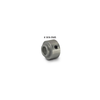
Stock Drive Products & Sterling Instrument - SDP/SI Rigid coupling with bores of 0.1875 / 0.3125" on opposite sides A 5C 9-0610

Description
Couplings Types Couplings can be divided into two categories: flexible and rigid. Both types are used to connect two rotating shafts driven by a motor and transmit torque and angular velocity; however, flexible couplings and shafts are designed to accommodate angular misalignment, angular offset, axial movement, and a variety of load conditions. A flexible coupling is pliable due to the twisting and compression of a durable, adaptable material, like neoprene, rubber, or silicone. Flexibility can also be achieved with thin metal disks, corrugated aluminum bellows (bellows couplings), or even a stainless-steel ball (miniature ball couplings). Some materials can provide vibration reduction, as in our precision flexible antivibration couplings. Rigid couplings are limited by comparison; rigid couplings are used when shafts are already positioned in precise lateral and angular alignment. Their rigid design inhibits shaft misalignment. They can generally transmit more power than flexible couplings due to their rigidity. Even the most complicated application challenges can be solved by our skilled engineers, they will identify the best coupling solution for your application. SDP/SI provides a comprehensive range of rigid and flexible couplings. Many of our precision couplings, including the Miniature Bellows Coupling and the Neo-Flex Coupling, have our patented Fairloc® Hub design, which solves phasing, timing, positioning, and frequent removal problems. For more about the easily adjustable Fairloc® hub design click here. Precision Magnetic Disk Couplings Precision Flexible Bellows Couplings Precision Miniature Ball Couplings Precision Flexible Antivibration Couplings 1 2 3 4
Request a Quote
Description
Couplings Types Couplings can be divided into two categories: flexible and rigid. Both types are used to connect two rotating shafts driven by a motor and transmit torque and angular velocity; however, flexible couplings and shafts are designed to accommodate angular misalignment, angular offset, axial movement, and a variety of load conditions. A flexible coupling is pliable due to the twisting and compression of a durable, adaptable material, like neoprene, rubber, or silicone. Flexibility can also be achieved with thin metal disks, corrugated aluminum bellows (bellows couplings), or even a stainless-steel ball (miniature ball couplings). Some materials can provide vibration reduction, as in our precision flexible antivibration couplings. Rigid couplings are limited by comparison; rigid couplings are used when shafts are already positioned in precise lateral and angular alignment. Their rigid design inhibits shaft misalignment. They can generally transmit more power than flexible couplings due to their rigidity. Even the most complicated application challenges can be solved by our skilled engineers, they will identify the best coupling solution for your application. SDP/SI provides a comprehensive range of rigid and flexible couplings. Many of our precision couplings, including the Miniature Bellows Coupling and the Neo-Flex Coupling, have our patented Fairloc® Hub design, which solves phasing, timing, positioning, and frequent removal problems. For more about the easily adjustable Fairloc® hub design click here. Precision Magnetic Disk Couplings Precision Flexible Bellows Couplings Precision Miniature Ball Couplings Precision Flexible Antivibration Couplings 1 2 3 4
Request a Quote
Datasheet
Datasheet Summary
Powered by GS/AI

The Rigid Coupling A 5C 9-0610 features bores of 0.1875 inches and 0.3125 inches on opposite sides, making it suitable for connecting shafts that are precisely aligned. Constructed from steel and zinc plated, this coupling offers durability and resistance to corrosion. It is designed to transmit torque effectively without accommodating misalignment, which is ideal for applications where shafts are already in alignment. The coupling includes set screws for secure attachment, ensuring reliable performance in various mechanical setups. This product is appropriate for engineers seeking a robust solution for rigid shaft connections in their projects.

Datasheet Summary
Powered by GS/AI

The Rigid Coupling A 5C 9-0610 features bores of 0.1875 inches and 0.3125 inches on opposite sides, making it suitable for connecting shafts that are precisely aligned. Constructed from steel and zinc plated, this coupling offers durability and resistance to corrosion. It is designed to transmit torque effectively without accommodating misalignment, which is ideal for applications where shafts are already in alignment. The coupling includes set screws for secure attachment, ensuring reliable performance in various mechanical setups. This product is appropriate for engineers seeking a robust solution for rigid shaft connections in their projects.

Suppliers

Company
Product
Description
Supplier Links
Rigid coupling with bores of 0.1875 / 0.3125
Hicksville, NY, United States
Rigid coupling with bores of 0.1875 / 0.3125" on opposite sides
A 5C 9-0610
Rigid coupling with bores of 0.1875 / 0.3125" on opposite sides A 5C 9-0610
Couplings Types Couplings can be divided into two categories: flexible and rigid. Both types are used to connect two rotating shafts driven by a motor and transmit torque and angular velocity; however, flexible couplings and shafts are designed to accommodate angular misalignment, angular offset, axial movement, and a variety of load conditions. A flexible coupling is pliable due to the twisting and compression of a durable, adaptable material, like neoprene, rubber, or silicone. Flexibility can also be achieved with thin metal disks, corrugated aluminum bellows (bellows couplings), or even a stainless-steel ball (miniature ball couplings). Some materials can provide vibration reduction, as in our precision flexible antivibration couplings. Rigid couplings are limited by comparison; rigid couplings are used when shafts are already positioned in precise lateral and angular alignment. Their rigid design inhibits shaft misalignment. They can generally transmit more power than flexible couplings due to their rigidity. Even the most complicated application challenges can be solved by our skilled engineers, they will identify the best coupling solution for your application. SDP/SI provides a comprehensive range of rigid and flexible couplings. Many of our precision couplings, including the Miniature Bellows Coupling and the Neo-Flex Coupling, have our patented Fairloc® Hub design, which solves phasing, timing, positioning, and frequent removal problems. For more about the easily adjustable Fairloc® hub design click here. Precision Magnetic Disk Couplings Precision Flexible Bellows Couplings Precision Miniature Ball Couplings Precision Flexible Antivibration Couplings 1 2 3 4

Couplings Types

Couplings can be divided into two categories: flexible and rigid. Both types are used to connect two rotating shafts driven by a motor and transmit torque and angular velocity; however, flexible couplings and shafts are designed to accommodate angular misalignment, angular offset, axial movement, and a variety of load conditions. A flexible coupling is pliable due to the twisting and compression of a durable, adaptable material, like neoprene, rubber, or silicone.


Flexibility can also be achieved with thin metal disks, corrugated aluminum bellows (bellows couplings), or even a stainless-steel ball (miniature ball couplings). Some materials can provide vibration reduction, as in our precision flexible antivibration couplings.

Rigid couplings are limited by comparison; rigid couplings are used when shafts are already positioned in precise lateral and angular alignment. Their rigid design inhibits shaft misalignment. They can generally transmit more power than flexible couplings due to their rigidity.

Even the most complicated application challenges can be solved by our skilled engineers, they will identify the best coupling solution for your application. SDP/SI provides a comprehensive range of rigid and flexible couplings. Many of our precision couplings, including the Miniature Bellows Coupling and the Neo-Flex Coupling, have our patented Fairloc® Hub design, which solves phasing, timing, positioning, and frequent removal problems. For more about the easily adjustable Fairloc® hub design click here.


Precision Magnetic Disk Couplings


Precision Flexible Bellows Couplings


Precision Miniature Ball Couplings


Precision Flexible Antivibration Couplings


  • 1
  • 2
  • 3
  • 4
Supplier's Site Datasheet

Technical Specifications

  Stock Drive Products & Sterling Instrument - SDP/SI
Product Category Rigid Couplings
Product Number A 5C 9-0610
Product Name Rigid coupling with bores of 0.1875 / 0.3125" on opposite sides
Material Steel / Zinc Plated
Units English Design Arrangement
Bore 1 0.1875 inch (4.76 mm)
Unlock Full Specs
to access all available technical data

Similar Products

Precision Multijaw Coupling, .1873
Specs
Units English Design Arrangement
Bore 1 0.1873 inch (4.76 mm)
O.D. 0.7500 inch (19.05 mm)
View Details
Stainless Steel / Precision Gear and dial hub, 5mm Bore, 14mm hub Dia. - S2F0MYM060050 - Stock Drive Products & Sterling Instrument - SDP/SI
Specs
Material Stainless Steel; ST. Steel / Precision
Bore 1 0.1969 inch (5 mm)
View Details
20mm long Brass - Black ox. Rigid Coupling With Opposing Bores of 8 & 5mm. - S51CBYM050080 - Stock Drive Products & Sterling Instrument - SDP/SI
Specs
Material Brass - Black ox.
Units Metric Design Arrangement
Bore 1 0.3150 inch (8 mm)
View Details
Stainless Steel / Precision Gear & Dial Hub, 0.1248
Specs
Bore 1 0.1248 inch (3.17 mm)
View Details