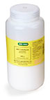
Bio-Rad Laboratories, Inc. AG 1-X2 Resin 140-1231

Description
500 g, analytical grade anion exchange resin, chloride form, 2% crosslinkage, 50-100 dry mesh size, 180-500 µm wet bead size, ~2,700 MW limit  AG, AG-MP, and Bio-Rex 5 Resins AG (analytical grade) resins — AG resins are extensively purified to remove both organic and inorganic impurities. Resins are sized to consistently give narrow wet mesh ranges, which provide high resolution and excellent reproducibility. AG resins are available as both strong and weak cation and anion exchangers and as mixed-bed ion exchangers. Many are available in several ionic forms and can be converted from one form to another. AG resins are primarily used for the separation of low molecular weight compounds such as inorganic ions, organic acids, nucleic acids, or carbohydrates. AG 1 and 2 resins are strongly basic anion exchangers with quaternary ammonium functional groups attached to the styrene divinylbenzene copolymer lattice. The amount of resin crosslinkage determines the bead pore size. A resin with a lower percentage of crosslinkage has a more open structure permeable to higher molecular weight substances than a highly crosslinked resin. It also has a lower physical resistance to shrinking and swelling, so that it absorbs more water and swells to a larger wet diameter than highly crosslinked resin of equivalent dry diameter. The lowered crosslinked resins, such as AG 1-X2, are useful for the sorption and fractionation of relatively high molecular weight substances such as peptides, ribo- and deoxyribonucleotides , and uranium. The higher crosslinked resins, such as AG 1-X8, are used for sorption, exchange, and separation of low molecular weight inorganic anions, and in applications such as cyclic nucleotide assays and fractionation of organic acids. AG MP-1M resin — this resin is the macroporous equivalent of AG 1 resin. Its effective surface area approximates 23 square meters per dry gram, 20% porosity. Bio-Rex 5 resins — contain primarily tertiary, but also some quaternary, amines on a styrene divinylbenzene lattice. Bio-Rex 5 resins exchange anions, such as iodide, bromide, and chloride, with weak interactions, allowing easy elution and regeneration. Bio-Rex 5 resins have an affinity for organic acids that can be used to remove acids from sugars. It is available in two dry mesh sizes (100–200 and 200–400) and are all analytical grade purity. They have been exhaustively sized, purified, and converted to make them suitable for accurate, reproducible analytical techniques. Molecular Biology and Biotechnology Grade Resins
Description
500 g, analytical grade anion exchange resin, chloride form, 2% crosslinkage, 50-100 dry mesh size, 180-500 µm wet bead size, ~2,700 MW limit  AG, AG-MP, and Bio-Rex 5 Resins AG (analytical grade) resins — AG resins are extensively purified to remove both organic and inorganic impurities. Resins are sized to consistently give narrow wet mesh ranges, which provide high resolution and excellent reproducibility. AG resins are available as both strong and weak cation and anion exchangers and as mixed-bed ion exchangers. Many are available in several ionic forms and can be converted from one form to another. AG resins are primarily used for the separation of low molecular weight compounds such as inorganic ions, organic acids, nucleic acids, or carbohydrates. AG 1 and 2 resins are strongly basic anion exchangers with quaternary ammonium functional groups attached to the styrene divinylbenzene copolymer lattice. The amount of resin crosslinkage determines the bead pore size. A resin with a lower percentage of crosslinkage has a more open structure permeable to higher molecular weight substances than a highly crosslinked resin. It also has a lower physical resistance to shrinking and swelling, so that it absorbs more water and swells to a larger wet diameter than highly crosslinked resin of equivalent dry diameter. The lowered crosslinked resins, such as AG 1-X2, are useful for the sorption and fractionation of relatively high molecular weight substances such as peptides, ribo- and deoxyribonucleotides , and uranium. The higher crosslinked resins, such as AG 1-X8, are used for sorption, exchange, and separation of low molecular weight inorganic anions, and in applications such as cyclic nucleotide assays and fractionation of organic acids. AG MP-1M resin — this resin is the macroporous equivalent of AG 1 resin. Its effective surface area approximates 23 square meters per dry gram, 20% porosity. Bio-Rex 5 resins — contain primarily tertiary, but also some quaternary, amines on a styrene divinylbenzene lattice. Bio-Rex 5 resins exchange anions, such as iodide, bromide, and chloride, with weak interactions, allowing easy elution and regeneration. Bio-Rex 5 resins have an affinity for organic acids that can be used to remove acids from sugars. It is available in two dry mesh sizes (100–200 and 200–400) and are all analytical grade purity. They have been exhaustively sized, purified, and converted to make them suitable for accurate, reproducible analytical techniques. Molecular Biology and Biotechnology Grade Resins

Suppliers

Company
Product
Description
Supplier Links
AG 1-X2 Resin - 140-1231 - Bio-Rad Laboratories, Inc.
Hercules, CA, USA
AG 1-X2 Resin
140-1231
AG 1-X2 Resin 140-1231
500 g, analytical grade anion exchange resin, chloride form, 2% crosslinkage, 50-100 dry mesh size, 180-500 µm wet bead size, ~2,700 MW limit  AG, AG-MP, and Bio-Rex 5 Resins AG (analytical grade) resins — AG resins are extensively purified to remove both organic and inorganic impurities. Resins are sized to consistently give narrow wet mesh ranges, which provide high resolution and excellent reproducibility. AG resins are available as both strong and weak cation and anion exchangers and as mixed-bed ion exchangers. Many are available in several ionic forms and can be converted from one form to another. AG resins are primarily used for the separation of low molecular weight compounds such as inorganic ions, organic acids, nucleic acids, or carbohydrates. AG 1 and 2 resins are strongly basic anion exchangers with quaternary ammonium functional groups attached to the styrene divinylbenzene copolymer lattice. The amount of resin crosslinkage determines the bead pore size. A resin with a lower percentage of crosslinkage has a more open structure permeable to higher molecular weight substances than a highly crosslinked resin. It also has a lower physical resistance to shrinking and swelling, so that it absorbs more water and swells to a larger wet diameter than highly crosslinked resin of equivalent dry diameter. The lowered crosslinked resins, such as AG 1-X2, are useful for the sorption and fractionation of relatively high molecular weight substances such as peptides, ribo- and deoxyribonucleotides , and uranium. The higher crosslinked resins, such as AG 1-X8, are used for sorption, exchange, and separation of low molecular weight inorganic anions, and in applications such as cyclic nucleotide assays and fractionation of organic acids. AG MP-1M resin — this resin is the macroporous equivalent of AG 1 resin. Its effective surface area approximates 23 square meters per dry gram, 20% porosity. Bio-Rex 5 resins — contain primarily tertiary, but also some quaternary, amines on a styrene divinylbenzene lattice. Bio-Rex 5 resins exchange anions, such as iodide, bromide, and chloride, with weak interactions, allowing easy elution and regeneration. Bio-Rex 5 resins have an affinity for organic acids that can be used to remove acids from sugars. It is available in two dry mesh sizes (100–200 and 200–400) and are all analytical grade purity. They have been exhaustively sized, purified, and converted to make them suitable for accurate, reproducible analytical techniques. Molecular Biology and Biotechnology Grade Resins

500 g, analytical grade anion exchange resin, chloride form, 2% crosslinkage, 50-100 dry mesh size, 180-500 µm wet bead size, ~2,700 MW limit


AG, AG-MP, and Bio-Rex 5 Resins

AG (analytical grade) resins — AG resins are extensively purified to remove both organic and inorganic impurities. Resins are sized to consistently give narrow wet mesh ranges, which provide high resolution and excellent reproducibility. AG resins are available as both strong and weak cation and anion exchangers and as mixed-bed ion exchangers. Many are available in several ionic forms and can be converted from one form to another. AG resins are primarily used for the separation of low molecular weight compounds such as inorganic ions, organic acids, nucleic acids, or carbohydrates.

AG 1 and 2 resins are strongly basic anion exchangers with quaternary ammonium functional groups attached to the styrene divinylbenzene copolymer lattice. The amount of resin crosslinkage determines the bead pore size. A resin with a lower percentage of crosslinkage has a more open structure permeable to higher molecular weight substances than a highly crosslinked resin. It also has a lower physical resistance to shrinking and swelling, so that it absorbs more water and swells to a larger wet diameter than highly crosslinked resin of equivalent dry diameter. The lowered crosslinked resins, such as AG 1-X2, are useful for the sorption and fractionation of relatively high molecular weight substances such as peptides, ribo- and deoxyribonucleotides, and uranium. The higher crosslinked resins, such as AG 1-X8, are used for sorption, exchange, and separation of low molecular weight inorganic anions, and in applications such as cyclic nucleotide assays and fractionation of organic acids.

AG MP-1M resin — this resin is the macroporous equivalent of AG 1 resin. Its effective surface area approximates 23 square meters per dry gram, 20% porosity.

Bio-Rex 5 resins — contain primarily tertiary, but also some quaternary, amines on a styrene divinylbenzene lattice. Bio-Rex 5 resins exchange anions, such as iodide, bromide, and chloride, with weak interactions, allowing easy elution and regeneration. Bio-Rex 5 resins have an affinity for organic acids that can be used to remove acids from sugars. It is available in two dry mesh sizes (100–200 and 200–400) and are all analytical grade purity. They have been exhaustively sized, purified, and converted to make them suitable for accurate, reproducible analytical techniques.

Molecular Biology and Biotechnology Grade Resins

Supplier's Site

Technical Specifications

  Bio-Rad Laboratories, Inc.
Product Category Ion Exchange Resins
Product Number 140-1231
Product Name AG 1-X2 Resin
Filter Medium Material Anion Exchange Resin
Unlock Full Specs
to access all available technical data

Similar Products

Dry Resin Ion Exchange Cartridge - ET Series - Hilliard Corporation (The)
Specs
Filter Medium Material Anion Exchange Resin
Application / Industry Hydrocarbon; Power Generation; Mining, Marine/Shipping, Steel Industries
View Details
Ion Exchange Resins -  - BakerCorp
Specs
Filter Medium Material Anion Exchange Resin; Cation Exchange Resin
Application / Industry Highly Complex Applications Such as Perchlorate and Dissoved Metals Removal
View Details
Bio-Rex 70 Resin - 142-5842 - Bio-Rad Laboratories, Inc.
Bio-Rad Laboratories, Inc.
Specs
Filter Medium Material Anion Exchange Resin
View Details