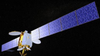
The first multifunctional geostationary satellite for South Korea.
Airbus Defence and Space was contracted by the South Korean Aerospace and Research Institute (KARI), to design and manufacture the country’s first multifunctional geostationary satellite, COMS (Communication, Ocean and Meteorological Satellite).
The highly advanced satellite carries three payloads, one for meteorology, one for ocean observation and one for communications. COMS provides meteorological data to end-users around the globe, oceanographic data for the Korean peninsula and experimental Ka-band broadband and multimedia communications services.
COMS was the third Earth observation spacecraft to be designed and manufactured for the Asia–Pacific region by Airbus Defence and Space, confirming the company’s leading position in this market. The overall programme was coordinated by KARI with the participation of several ministries in South Korea. Airbus Defence and Space was responsible for system and satellite design, satellite development and technical support to KARI for ground segment development and launch services.
The spacecraft weighed around 2.6 tonnes at launch and will have 2.5kW of electrical power at end of life. The satellite, operating from geostationary orbit, is providing services for a minimum of seven years. COMS is based on Airbus Defence and Space’s Eurostar E3000 avionics system, with some modifications to accommodate the optical payload constraints (addition of fibre optics gyros, five-wheel stack, payload mission management).
COMS was launched by an Ariane 5 from Kourou, French Guiana, on 26 June 2010.
Fact Sheet
| Customer | Korean Aerospace Research Institute (KARI) |
| Mission | The COMS system has three main missions • Meteorological information as part of the international worldwide network of meteorological geostationary satellites • Ocean Colour images over the Korean peninsula to assess ecological trends of surrounding seas, and to provide fisheries information • Experimental wide band communications using Ka-band |
| Orbit | Geo-synchronous |
| Spacecraft | • Eurostar 3000 avionics • Power: 11m2 AsGa solar cells, Li Ion 192Ah |
| Payload | • Ocean Colour Instrument • Ka-band communications • Meteo Imager |
| Features | • Pointing stability 10μrad (N/S and E/W) peak to peak over 8s period • Pointing error ±0,1˚ (R/P) for MI and GOCI |
| Launch Mass | ~2500 kg, payload mass=320 kg |
| Dimensions | 2m x 2.4m x 3.3m |
| Launch Date | 2010 |
| Mission Duration | 10 years |
| Airbus Defence and Space Responsibilities | • Satellite prime contractor • Image Navigation & Registration ground software • Ocean Colour Instrument • Solar array • Propulsion • MODCS (through TESAT) |
| Airbus Group | |
|---|---|
| Product Category | Satellites |
| Product Number | COMS |
| Product Name | Earth Observation Satellite |