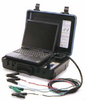
Motor testers measure motor performance at no load and at pre-defined load(s). Setting parameters for motor voltage, applied torque, and measure resulting motor current and speed while ramping applied motor torque to develop the complete motor performance characteristic graphs.
All tests can be performed for motor rotation in both clockwise and counter-clockwise directions.
Software shall monitor for fail conditions such as, but not limited to:
Power supply current foldback
Power supply voltage out of expected range
Torque load out of expected range
Excessive time to complete test
Typical drivetrain for dyno testing of motors
Torque transducer to monitor loading
Encoder to monitor angular position
Hysteresis, eddy current or particle brakes to apply
resistive loading
Clutch to couple / decouple drivetrain
Servomotor to apply backdrive / engage spring
coupling with DUT
Motor testers measure motor performance at no load and at pre-defined load(s). Setting parameters for motor voltage, applied torque, and measure resulting motor current and speed while ramping applied motor torque to develop the complete motor performance characteristic graphs.
All tests can be performed for motor rotation in both clockwise and counter-clockwise directions.
Software shall monitor for fail conditions such as, but not limited to:
- Power supply current foldback
- Power supply voltage out of expected range
- Torque load out of expected range
- Excessive time to complete test
Typical drivetrain for dyno testing of motors
- Torque transducer to monitor loading
- Encoder to monitor angular position
- Hysteresis, eddy current or particle brakes to apply
- resistive loading
- Clutch to couple / decouple drivetrain
- Servomotor to apply backdrive / engage spring
- coupling with DUT